 magnon@magnon.es



Innovation, sustainability
and the future

Innovation, sustainability
and the future
Towards the renewable fuels of the future
We are moving forward with the development of a pioneering project in Spain for the capture of biogenic CO₂ (of plant origin) and its transformation into renewable methanol, a clean fuel that will help decarbonise the economy by providing efficient alternatives for sectors such as maritime transport and aviation.
For this initiative, the company is committed to the creation of a renewable fuels production platform that it will promote from its energy complexes in Mérida, Puertollano and Huelva. These plants will continue to produce renewable electricity from biomass, and with the implementation of this project a new layer of value will be added: in addition to generating electricity, a biogenic CO₂ capture system will be incorporated to transform it into green methanol, reinforcing Magnon’s commitment to the energy transition.
All the information
Methanol is a product with great potential in the decarbonisation process. It is used in the manufacture of essential products such as acrylic plastics, adhesives and paints, as well as in the pharmaceutical and agrochemical industries, among others. Its liquid state at ambient temperature and pressure facilitates transport and storage, and it benefits from a wide global logistics network.
Currently, most methanol is produced from natural gas and coal, contributing to greenhouse gas emissions. Magnon’s plant will promote the production of renewable methanol (e-methanol), based on biogenic CO₂, which can be used directly as a maritime fuel or converted into sustainable aviation fuel (SAF).

What is biogenic CO₂?
The combustion of biomass releases biogenic CO₂, that is, the same carbon dioxide that plants previously absorbed from the atmosphere during photosynthesis. It is therefore considered carbon neutral: it is part of a natural cycle that does not increase the overall concentration of greenhouse gases, unlike the combustion of fossil fuels.
Andalusia | Huelva
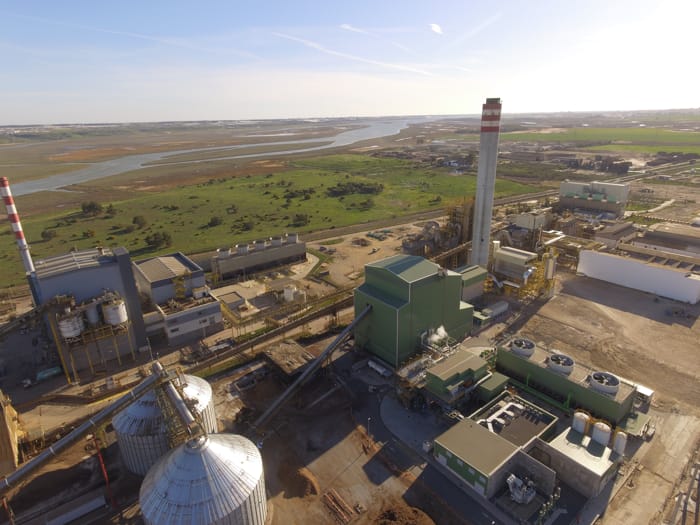
Huelva Energy Complex
- Direct contribution to Spain’s and the EU’s climate objectives.
- Diversification of the national energy mix.
- Use of existing logistics infrastructure at local and global level.
The project will be developed at Magnon’s renewable energy complex in Huelva, the leading generator of biogenic CO₂ in Spain. The initiative aims to turn the site into a benchmark hub for the production of renewable fuels and the capture of biogenic CO₂.
- It is the largest biomass-based power generation centre in Spain, producing more than 800 GWh of renewable electricity each year.
- More than 800,000 tonnes per year of nearby agricultural and forestry residues are recovered.
- The industrial complex has fully operational infrastructure, electrical connections and logistics facilities. Making use of them reduces costs, avoids duplicating installations and minimises environmental and visual impacts.
- It is aligned with the direction of European regulations (Renewable Energy Directive), which promote the development of new energy vectors on previously transformed industrial land.
The location of Huelva provides a unique strategic advantage:
- Pioneers in the capture and utilization of biogenic CO₂ emitted in existing biomass power plants. This complex currently emits 1,255,000 tons of biogenic CO₂ per year.
- The complex is located next to a top-tier port, with access to international maritime transport networks and at the heart of a key region for the development of renewable energy projects in Spain.
- This facilitates both the export and the supply of green methanol to sectors such as maritime and industrial, which are precisely the ones that most need these alternatives.

For more information:
co2biogenicohuelva@magnon.es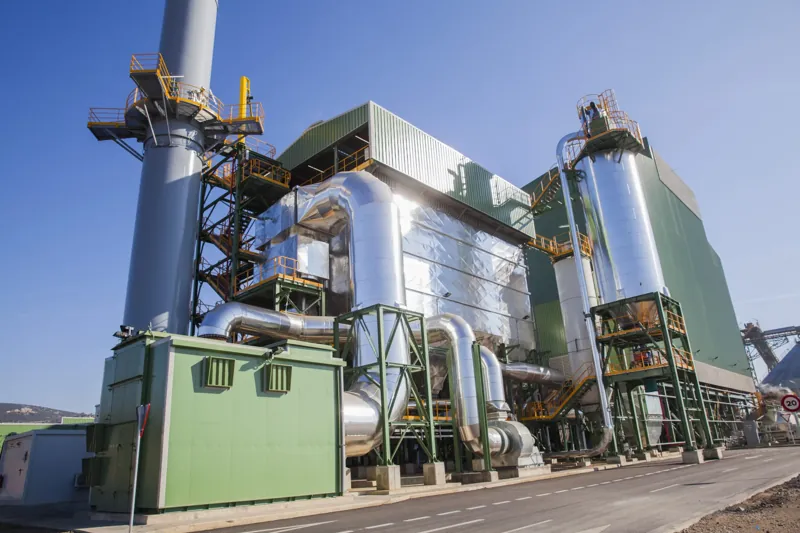
Castile-La Mancha | Ciudad Real
Puertollano Energy Complex
- Direct contribution to Spain’s and the EU’s climate objectives.
- Diversification of the national energy mix.
- Use of existing logistics infrastructure at local and global level.
Magnon is committed to the development of a renewable methanol generation plant at its Puertollano facilities, which will use the CO₂ captured from the flue gases of the existing biomass plant (Puertollano 1) and its twin plant, currently undergoing environmental permitting (Puertollano 2), together with the renewable hydrogen generated by the project at the same site.
The project would involve the construction of up to three facilities aimed at producing methanol from hydrogen generated via water electrolysis and CO₂ captured from the biomass power plant, using primarily electricity from renewable sources.
Thus, it would include:
- This complex currently emits 375,000 tons of biogenic CO₂ per year.
- A CO₂ capture and liquefaction facility for emissions from the complex’s boilers, intended for use in the production of green methanol and for exporting the remaining captured CO₂, with a capacity of 758,000 tonnes per year.
For more information:
co2biogenicopuertollano@magnon.es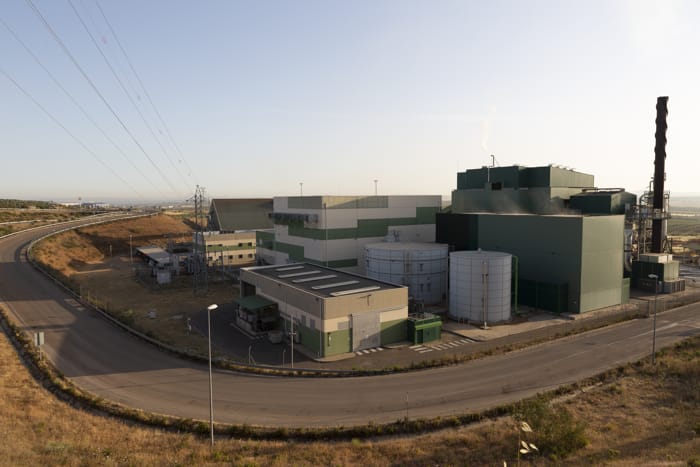
Extremadura | Mérida
Mérida Energy Complex
- Direct contribution to Spain’s and the EU’s climate objectives.
- Diversification of the national energy mix.
- Use of existing logistics infrastructure at local and global level.
Magnon will promote the development of a new renewable methanol production plant at its Mérida complex, using the CO₂ captured at the existing biomass plant in Mérida, as well as the renewable hydrogen generated by the project at the site.
The initiative includes the construction of a CO₂ capture and liquefaction plant using CO₂ from the complex’s boilers. This CO₂ will be used both for the production of green methanol and for export, with an expected capacity of close to 300,000 tonnes per year.
Additionally, a 370-megawatt renewable hydrogen production plant will be built, using water electrolysis powered by electricity from 100% renewable sources. This hydrogen, together with the captured CO₂, will be used as the basis for the production of renewable methanol. As an alternative operating mode, the plan also envisages the export of 380,000 tonnes of captured CO₂ per year.
In terms of employment, the project announced by Magnon will generate 500 jobs (direct, indirect and induced) during the construction phase, while in its operational phase the initiative will create 85 direct jobs.
For more information:
co2biogenicomerida@magnon.es
